
Your trusted partner in navigating workers' compensation claims with ease and expertise.

Workers' Compensation Insurance Coverage Matters
Did you know that our workers’ compensation team handles coverage matters as well? Attorney Brad Inman spearheads this effort with the full support of our Insurance Coverage Services team, bringing a wealth of institutional knowledge to the coverage disputes and considerations unique to workers’ compensation policies. Here are some of the issues we see on a regular basis:
- Policy Cancellation Issues
- Proof of Coverage Issues
- Disputes Between Carriers Over Cumulative Injuries
- Multi-Jurisdictional Coverage Considerations
- Defense of Bad Faith Claims
- Independent Contractors v. Employees
We represent private and public sector employers, government entities, insurance carriers and third-party administrators in all aspects of a workers’ compensation claim. Our goal is to provide practical and proactive legal advice; diligently manage accepted claims to reduce liability; employ results-oriented negotiation skills to promptly resolve contested cases, minimize defense costs and achieve finality; and, in those cases which cannot be resolved by compromise settlement, aggressively and effectively defend our clients before the Industrial Commission and in our appellate courts.
We believe in being responsive and providing guidance as a trusted advisor. Our workers’ compensation team can handle any issue that may arise in the workers’ compensation realm and always seek the best resolution for our clients, whether that requires litigation or a quick resolution. We offer a wide variety of continuing education courses and are regularly asked to present for industry events, membership organizations and law schools.
Teague Campbell attorneys have assisted in negotiating and drafting legislative changes to the Workers’ Compensation Act and bring that depth of knowledge to each client and every claim. We have been involved in over 180 workers’ compensation decisions before the North Carolina Court of Appeals and the Supreme Court and are the only North Carolina firm in the National Workers’ Compensation Defense Network. Our workers’ compensation attorneys are also consistently recognized by their peers in North Carolina Super Lawyers and The Best Lawyers in America©, with two current and one former partner receiving Lawyer of the Year designation.
Clients trust our unmatched experience.
Matters referenced are for illustrative purposes only. They do not represent the firm’s entire record and past successes are not a guarantee of any future result or outcome.
- Successfully defended case at the North Carolina Supreme Court, with the Court ultimately finding that the plaintiff’s fall off of the roof of a building owned by the defendant auto dealership did not arise out of or in the course of the plaintiff’s employment with the auto dealership.
- Successfully defended Moore County from nine alleged occupational disease “sick building” cases. The Court of Appeals affirmed the finding from the Full Commission at the plaintiffs failed to prove not only exposure, but any compensable consequences as a result of the alleged exposure.
- Successfully argued that the filing of a Form 60 does not create a presumption of disability. This was a case of first impression following the Workers’ Compensation Reform Act of 1993 and 1994 establishing direct pay of indemnity benefits and is the leading case establishing the distinction between a Form 21 agreement and a Form 60.
- Successfully argued to the North Carolina Supreme Court that a defendant carrier should be fully reimbursed for the workers’ compensation lien pursuant to G. S. 97-10.2. The case established that since the third-party judgment exceeded the amount of the workers compensation lien, the workers compensation carrier was entitled to a full recovery.
- Successfully argued to the North Carolina Supreme Court that the defendants rebutted any type of presumption of disability pursuant to a Form 21 agreement when the plaintiff is released to full duty employment.
- Successfully argued to the North Carolina Supreme Court that the defendants had demonstrated that plaintiff was no longer disabled and not entitled to ongoing TTD benefits despite having permanent work restrictions given that he was capable of returning to work in some capacity.
- The leading case in North Carolina establishing the guidelines required for a plaintiff to establish disability pursuant to the North Carolina Workers’ Compensation Act.
- Leading case establishing criteria for carrier’s responsibility for housing for a catastrophically injured plaintiff.
- Court of Appeals’ decision establishing that the Industrial Commission should look to a plaintiff’s profit and loss statement when calculating an average weekly wage for a sole proprietor.
- Leading case in North Carolina establishing the burden of proof for a plaintiff to prove disability in a workers’ compensation claim. Namely, that the plaintiff was incapable after his injury of earning the same wages earned before his injury in the same employment, that plaintiff was incapable after his injury of earning the same wages earned before his injury or any other employment, and that this individual’s incapacity to earn wages was caused by the work-related injury. The plaintiff has the burden of proving both the existence of his disability and the degree of disability.
- Successfully defended a case establishing apportionment of a plaintiffs total disability based upon only a portion (55%) of the claimant’s total incapacity for work being causally related to the compensable occupational disease, thereby reducing the plaintiff’s indemnity benefits by 45%.














No Proof, No Disability: The Court’s Message in Hall v. Jones – COA 25-59
Authors Jaden Grimes View all posts Tracey Jones View all posts


Teague Campbell Promotes Jonathan Gonzalez To Partner
Teague Campbell Dennis & Gorham, LLP is proud to announce the promotion of Jonathan Gonzalez to Partner. Based in the Charlotte Metro area, Jonathan serves clients statewide in the firm’s Workers’ Compensation and Employment Law practice groups, bringing a pragmatic, empathetic approach to every case. Jonathan earned both his undergraduate and law degrees from the…


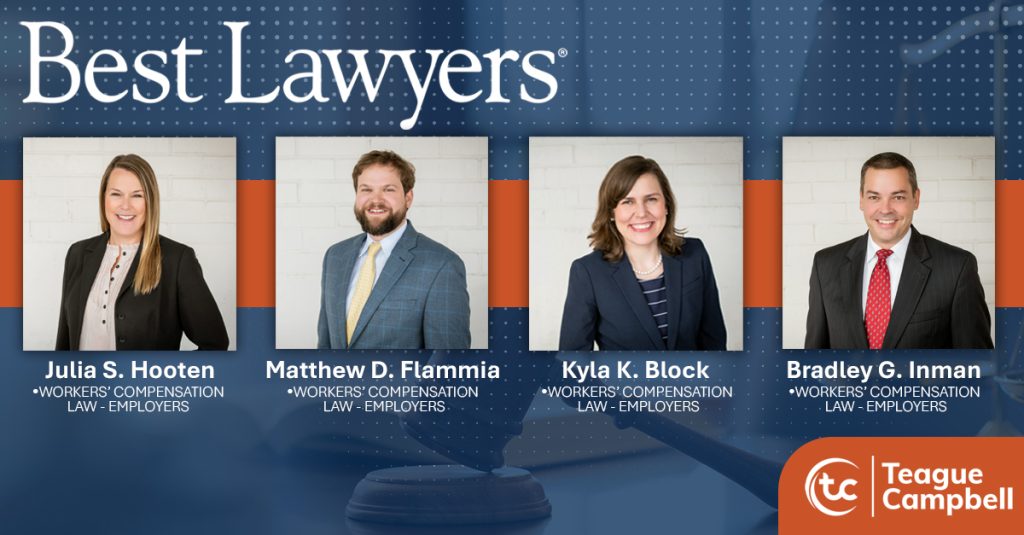
Teague Campbell Celebrates Best Lawyers – Workers’ Compensation
Author Hunter Schenk View all posts

The Danger is Real: Settling a Claim via Clincher with a Current Employee
The Industrial Commission and Court of Appeals decided a case recently that reiterates the potential exposures employers face when they clincher a claim with a current employee. While this practice is necessary in certain cases, there can be future exposures to the employer despite their best intentions to resolve any and all aspects of…
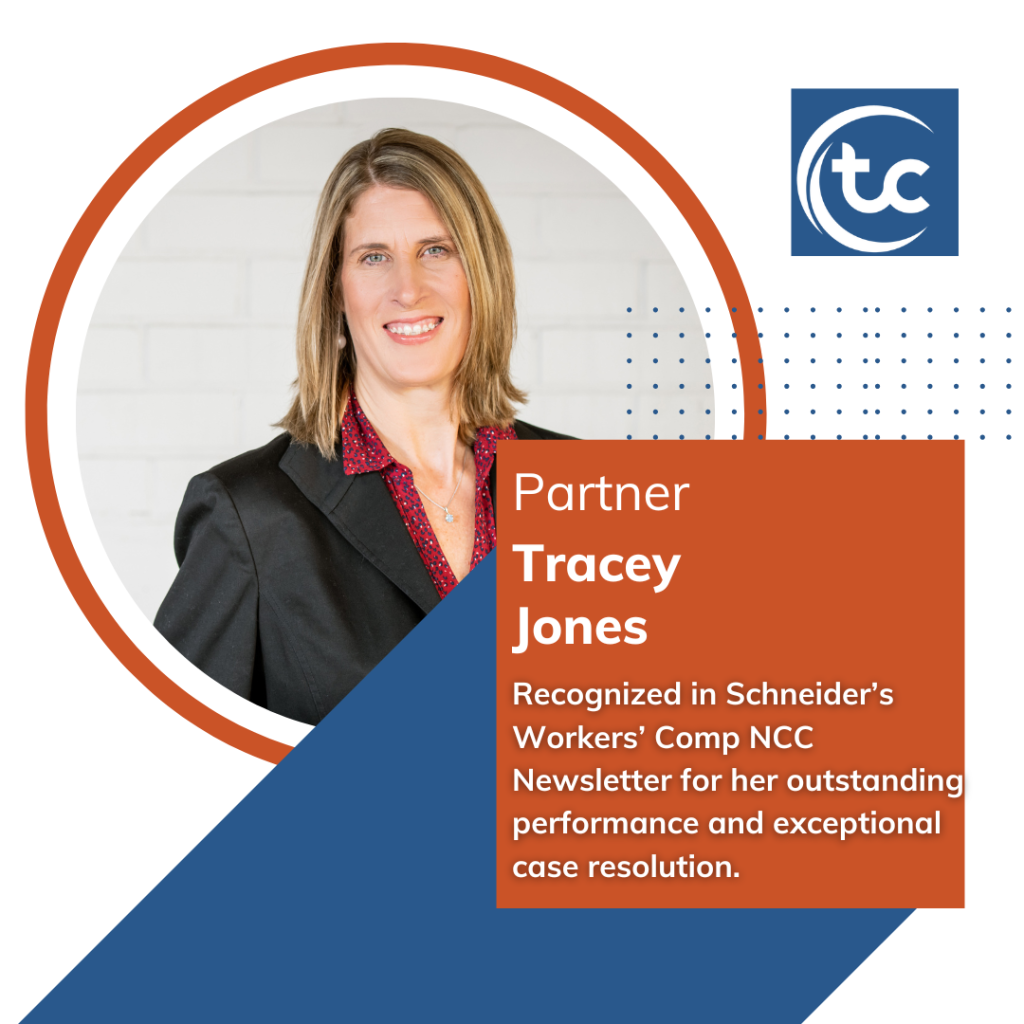
Tracey Jones Recognized For Outstanding Work
We are pleased to recognize Tracey Jones for her recent feature in Schneider’s Worker’s Comp NCC Newsletter. Tracey’s quick resolution of a complex litigation matter, combined with her ability to achieve a favorable early resolution, showcases the dedication and skill she brings to every case. We are proud to have Tracey as a leader…
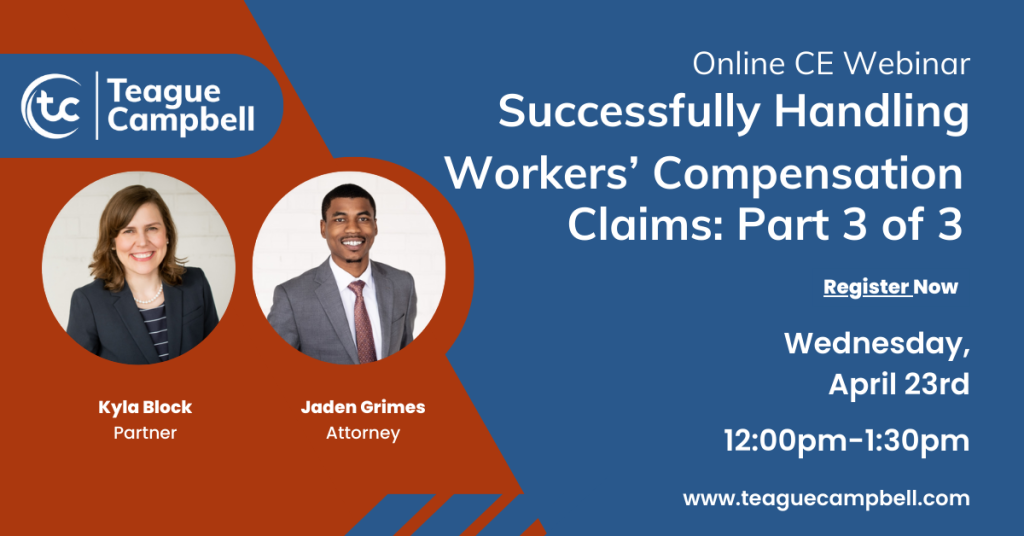
Free CE Webinar Mini-Series: NC Workers’ Comp Claims Part 3
Please join Kyla Block and Jaden Grimes on Wednesday, April 23, 2025, for the final part of our webinar mini-series, Successfully Handling Workers’ Compensation Claims. Gain valuable insights and practical strategies to navigate these cases with confidence. Register here: https://lnkd.in/ejHFMZ9S Author Hunter Schenk View all posts

Injury Reporting – NC Workers’ Comp Act
Effective resolution of a workers’ compensation claim begins by successfully navigating the injury reporting requirements of the NC Workers’ Compensation Act. Failure to do so can result in significant difficulties and issues throughout the life of the claim. Straightforward internal practices should be implemented to ensure accurate and proper claim reporting. Requirements under the…
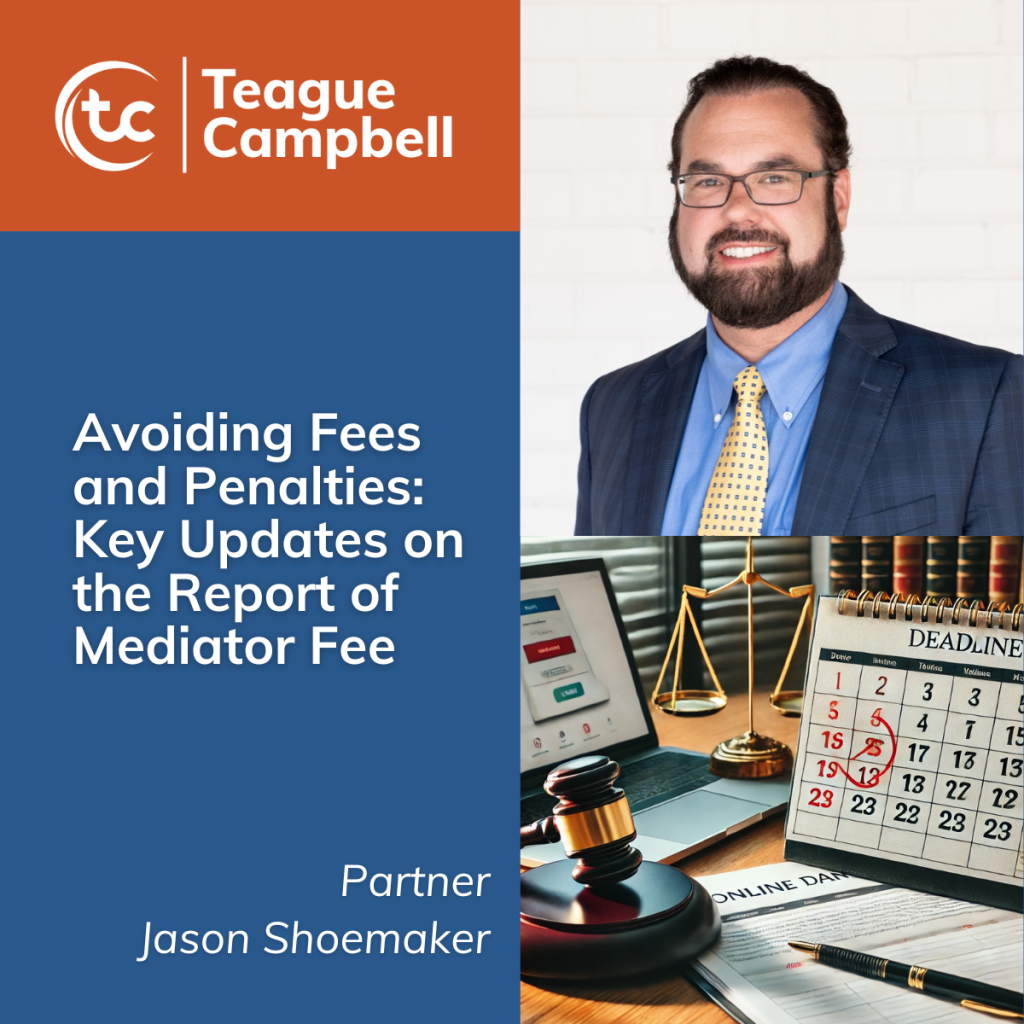
Avoiding Fees and Penalties: Key Updates on the Report of Mediator Fee
Anyone involved in workers’ compensation law—whether as a defense attorney, plaintiff’s attorney, adjuster, or injured worker—is familiar with the various fees collected by the North Carolina Industrial Commission. As we settle into 2025, it’s important to stay aware of deadlines and potential consequences for late payments. Recently, the Industrial Commission issued updated guidance on the…
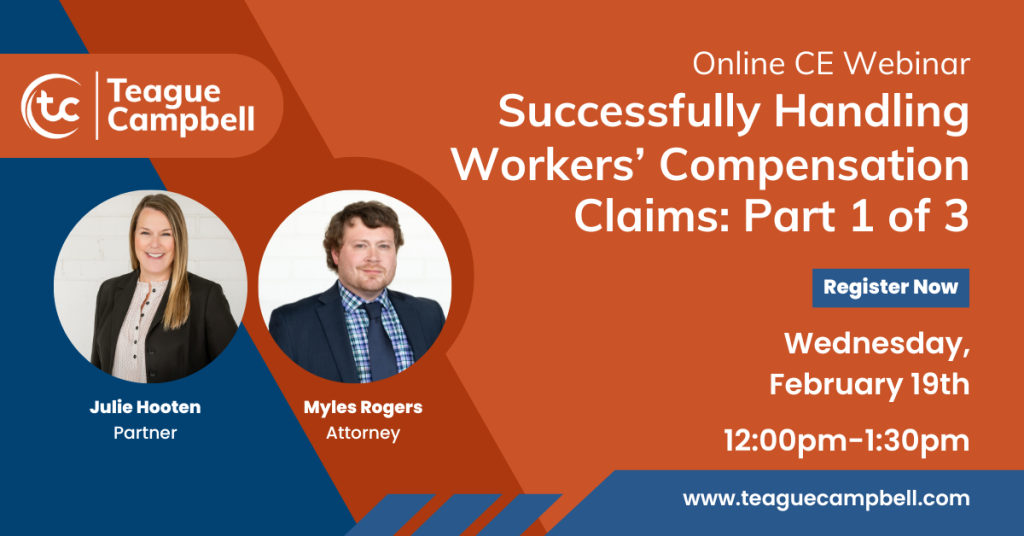
Free CE Webinar Mini-Series: NC Workers’ Comp Claims Part 1
Please join Julie Hooten and Myles Rogers on Wednesday, February 19th, for Part 1 of our webinar mini-series, Successfully Handling Workers’ Compensation Claims. Gain valuable insights and practical strategies to navigate these cases with confidence. Register here: https://lnkd.in/eNQgRpH Author cheinsohn View all posts

Defense Counsel Perspective: Five Tips for Preparing for Mediation
Author tjones View all posts

Why The Right to Direct Medical Treatment in a Workers’ Compensation Claim is not Absolute
Author kblock View all posts

Breaking News: Legislative Response To Extended Benefits Cases
Author mflammia View all posts

Navigating Workplace Violence Claims Under the North Carolina Workers’ Compensation Act
Author piper View all posts

Revisiting the Pleasant Standard: Estate of Rodney Baker v. David W. Reinhart and Randy Reinhardt
Author Teague Campbell View all posts



Gilliam v. Foothills Temporary Employment: Calculating Summer Employees’ Average Weekly Wage
Author piper View all posts


Withdrawal of Sturdivant v. NC DPS Opinion: The Impact on Workers’ Comp Extended Benefits
Author Teague Campbell View all posts




2023 Update on COVID-19 Workers’ Compensation Claims in North Carolina
Author mflammia View all posts

Attorneys Elizabeth Ligon and Logan Shipman Publish Article in LexisNexis Workers’ Compensation Emerging Issues Analysis
Author Teague Campbell View all posts

An Historical Analysis of North Carolina’s Extended Benefits Cap and Potential Constitutional Challenges to N.C. Gen. Stat. § 97-29
Author eligon View all posts

Two Return to Work Decisions Shed Light on Determining Factors Considered by NC Court of Appeals on Disability
Author Teague Campbell View all posts


From Deese to Booker: Workers’ Compensation Death Benefits in North Carolina
Author kblock View all posts

North Carolina Full Commission Reaffirms Applying Revised Standard in Third Extended Benefits Decision
Author tjones View all posts

Recent Full Commission Decision Provides Guidance on How to Navigate Requests for Second Opinions and Payment Under the Fee Schedule
Author Teague Campbell View all posts

Take Your Claimant How You Find Them: Reaffirming Eggshell Plaintiff Rule
Author Teague Campbell View all posts

Workers’ Compensation Coverage Considerations for Subcontractors
Author Teague Campbell View all posts

North Carolina Workers’ Compensation Disability Reduction and Credits
Author mflammia View all posts
Full Commission Affirms Denial in Another Extended Benefits Case Addressing “Total Loss of Wage-Earning Capacity”
Author tjones View all posts

Deductible Policy Provisions: Potential Cost Savings for Employers
Author Teague Campbell View all posts

Contesting Compensability: NC Court of Appeals Remands Case on Establishing Causation
Author Teague Campbell View all posts

NC Court of Appeals Remands Case on Converting Weekly Benefits to Lump-Sum Award to Full Commission
Authors jhooten View all posts tjones View all posts sshah View all posts

Common Questions Related to the Seven-Day Waiting Period for Workers’ Compensation Claims in North Carolina
Author jhooten View all posts

Updated Handling Recommendations for COVID-19 Workers’ Compensation Claims in North Carolina
Author mflammia View all posts

North Carolina Factors in Futility: Monroe v. MV Transportation
Author Teague Campbell View all posts
The Second NC Full Commission Decision Regarding an Extended Benefits Case is a Win for Defendants
Author tjones View all posts


2022 Medicare Safe Harbor & Reporting Threshold for Liability, No-Fault, and Workers’ Compensation Settlements Remains at $750
Author dhayes View all posts

The PAID Act is Now Active, Allowing Access to Enrollment Information for Medicare Parts C and D
Author dhayes View all posts

Recorded Statements: Tips for Workers’ Compensation Adjusters
Authors tjones View all posts Teague Campbell View all posts
Deputy Commissioner Issues Opinion and Award in Extended Benefits Case, Tapper v. Penske Logistics, LLC
Author eligon View all posts

Who Has Jurisdiction on a Workers’ Compensation Bad Faith Claim in NC?
Author Teague Campbell View all posts

Full Commission Reverses Decision in Extended Benefits Case, Milton Nobles v. NCDHHS and CCMSI
Author tjones View all posts

Early Trends in North Carolina Extended Benefits Cases and How Comparable Jurisdictions in the Southeast Have Analyzed Similar Statutory Caps
Author tjones View all posts

Voluntary CMS Submission: New Language in Consent to Release Form
Author dhayes View all posts

The Compensability of Adverse Reactions to Mandatory Vaccines in NC
Author Teague Campbell View all posts

Contractor and Subcontractor Liability in Workers’ Compensation: Who is the Statutory Employer?
Authors jhooten View all posts Teague Campbell View all posts


Section 111 Reporting: ORM Termination Dates in South Carolina
Author dhayes View all posts

What a Recent Court Decision Could Mean for Dismissing Workers’ Compensation Claims with Prejudice
Author eligon View all posts

Out-of-State Workers’ Compensation Injuries: NC Jurisdiction and Insurance Coverage Implications
Author Teague Campbell View all posts
Early Trends in North Carolina Extended Benefits Cases
Author Teague Campbell View all posts
Section 111 Reporting: ORM Termination Dates in North Carolina
Authors dhayes View all posts tjones View all posts


Four Common Types of Occupational Disease Lung Claims Compensable in North Carolina
Author tjones View all posts

Insurance Coverage Implications for Business Owners and Executives in North Carolina under the Workers’ Compensation Act
Author Teague Campbell View all posts

Communicable Diseases and Workers’ Compensation: Critical Factors for Determining Compensability, Part 3 of 3
Author Teague Campbell View all posts
Communicable Diseases and Workers’ Compensation: Critical Factors for Determining Compensability, Part 2 of 3
Author Teague Campbell View all posts
Futility Frustration: NC Supreme Court Affirms Workers’ Comp Decision on Disability
Author Teague Campbell View all posts
Communicable Diseases and Workers’ Compensation: Critical Factors for Determining Compensability, Part 1 of 3
Author Teague Campbell View all posts


Defending Psychological Workers’ Compensation Claims in North Carolina: Part 4 of 4
Author tjones View all posts
Defending Psychological Workers’ Compensation Claims in North Carolina: Part 3 of 4
Author tjones View all posts

2021 Medicare Safe Harbor & Reporting Threshold for Liability, No-Fault, and Workers’ Compensation Settlements
Author dhayes View all posts
Defending Psychological Workers’ Compensation Claims in North Carolina: Part 2 of 4
Author tjones View all posts

Reminders for NC Adjusters When Requesting Medical Information from Treating Physicians
Author tjones View all posts

Settlement Agreements—Not Always the End When Lacking Mutual Consent
Author eligon View all posts
Defending Psychological Workers’ Compensation Claims in North Carolina: Part 1 of 4
Author tjones View all posts
How to Effectively Cancel Workers’ Compensation Policies in North Carolina
Author Teague Campbell View all posts

Medicare Set Asides in Denied Workers’ Compensation Settlements
Author dhayes View all posts

Determining Average Weekly Wage in Occupational Disease Claims in NC
Author tjones View all posts


COVID-19 Updates from the National Workers’ Compensation Defense Network
Author Teague Campbell View all posts
Workers’ Compensation Medical Treatment During the COVID-19 Pandemic
Author mwoodard View all posts

COVID-19 and Workers’ Compensation Laws: A National Resource Bank from NWCDN
Author bhamilton View all posts

How Will Layoffs Due to COVID-19 Affect a Claimant’s Entitlement to Workers’ Compensation Indemnity Benefits?
Authors eligon View all posts bhamilton View all posts

COVID-19 and Workers’ Compensation Implications in North Carolina Due to an Increase in Teleworking
Authors bhamilton View all posts tjones View all posts

2020 Forecast: Overview of Upcoming Issues in Workers’ Compensation
Authors bhamilton View all posts Teague Campbell View all posts

Court of Appeals Sees Through Attempt to Skirt Workers’ Compensation Rules on Employees and Independent Contractors
Author bhamilton View all posts
Extended Benefits Beyond the 500 Week Cap: Refresher on the 2011 Reforms
Authors bhamilton View all posts mflammia View all posts


Implications of Recent Case Law on the Exclusive Remedy Doctrine
Authors bhamilton View all posts eligon View all posts
Kyla Block and Melissa Woodard Obtain Favorable Opinion from Full Commission Regarding Nuanced Disability Claim
Authors kblock View all posts mwoodard View all posts
Does NC COA decision in Jackson v. The Timken Co. threaten the exclusive remedy doctrine?
Authors tjones View all posts cstipes View all posts



Supporting #KidsChance
Bruce Hamilton and Heather Baker visiting Kids’ Chance of America at the National Workers’ Compensation & Disability Conference in Las Vegas. Author Teague Campbell View all posts

Emerging Issues: Workplace Harassment and Workers’ Compensation in the #MeToo Era
Author cbritt View all posts

Intoxication and Work-Related Injuries: Pitfalls and Advice
With prescription drug and opioid addiction on the rise in America and an estimated 20 million Americans in need of treatment for drug or alcohol addiction, the prevalence of drug and alcohol use in the workplace is a serious concern for employers. As you might imagine, working under the influence of an intoxicating substance can…
Mixed Results In Appeal Of Civil Suit By Workers’ Compensation Insurer, Company Representatives
A recent civil case involving a workers’ compensation claim examines the bounds of third-party beneficiary status in North Carolina. Seguro-Suarez v. Key Risk Insurance Co. began as a workers’ compensation case filed at the North Carolina Industrial Commission. However, the case recently decided by North Carolina’s Court of Appeals is a civil case which was…

Elizabeth Ligon Leads Panel for NWCDN
Teague Campbell attorney Elizabeth Ligon led a panel on managing multi-jurisdictional issues and their challenges with Elizabeth Bailey of Waffle House and Tom Shaver of Zenith Insurance Company at the NWCDN Regional Conference in New Orleans, LA on July 20, 2018. The National Workers’ Compensation Defense Network (NWCDN) is a network of law firms dedicated…

News at the Industrial Commission
Commissioner Myra L. Griffin was confirmed to the Full Commission on June 29, 2018 to fill the unexpired term of former Commissioner Linda Cheatham. Governor Cooper appointed Commissioner Griffin as an emergency appointment to allow her to act as a Full Commissioner prior to her confirmation by the legislature. Commissioner Griffin will serve the remainder…
Did You Know? The IC Rules Have Been Recodified
Did you know that, effective June 1, 2018, the Industrial Commission’s Rules were recodified from Title 04 Chapter 10 of the North Carolina Administrative Code to Title 11 Chapter 23 of the Administrative Code? According to the NCIC’s website, all references and citations to an Industrial Commission Rule on or after June 1, 2018, should…
The Developing Disability Dilemma
Recent rulings from The North Carolina Supreme Court and Court of Appeals have set Workers’ Compensation Defendants somewhat adrift regarding the burdens of proof relating to disability. With this uncertainty, and to counter the testimony historically provided by Plaintiffs seeking indemnity benefits, Defendants involved in complicated disability disputes should consider early involvement of a vocational…

Tax Liens and Workers’ Compensation Benefits: Who Gets the Money?
Every employer has been there before. You hire a new employee and everything is going smoothly, until one day you receive a letter from the North Carolina Department of Revenue compelling you to withhold an amount from your new employee’s paychecks to satisfy an outstanding tax obligation the employee owes. In the boilerplate of that…

NCIC Opioid and Prescription Drug Rules Effective May 1, 2018
As the state of North Carolina continues its efforts to combat the opioid crisis, the Rules Review Commission, part of the North Carolina Industrial Commission, approved nine rules regarding opioids, prescriptions, and pain management in workers’ compensation claims that go into effect today, May 1, 2018. The rules are specifically meant to address problems arising…

“Common Sense Isn’t Enough”
The Court of Appeals recently held that Plaintiff’s lay testimony was insufficient to establish increased risk in an occupational disease claim. In Briggs v. Debbie’s Staffing, Inc., Plaintiff worked as a Ceramic Technician, which required him to work a portion of his time on a Voeller machine. The Voeller machine mixes water with various dry…
North Carolina Court of Appeals Issues Decisions Analyzing Disability Post-Wilkes
The Court of Appeals recently released two decisions that analyzed issues relating to disability – specifically, the burden of proving futility – post-Wilkes v. City of Greenville. In Adame v. Aerotek, an unpublished decision, Plaintiff sustained a low back injury in June 2013. After receiving conservative treatment with multiple doctors, Plaintiff was ultimately released with…
March Updates from the NC Industrial Commission
Two long-time Deputy Commissioners have recently been nominated by Governor Roy Cooper for appointment to the Full Commission. Deputy Commissioners Robert J. Harris and Myra L. Griffin have both served in their current roles since 2005, adjudicating cases and conducting full evidentiary hearings around the state. Their appointments are pending confirmation by the North Carolina…
Third Party Subrogation Liens
Workers’ compensation employers’ subrogation lien rights have received attention in recent years in the appellate courts. The North Carolina Supreme Court recently issued an opinion in Easter-Rozzelle v. City of Charlotte which clarified the impact of a third party settlement made without the written consent of the employer on the workers’ compensation claim, claimant’s entitlement…
Proposed Opioid and Prescription Rules Designed to Combat Opioid Crisis
Opioid use continues to be a growing crisis in North Carolina and across the country. In an effort to continue to take steps to reduce availability and use of prescription pain killers, the Rules Review Commission, part of the Industrial Commission, recently issued proposed rules regarding opioids, prescriptions, and pain management. The rules are specifically…

Truck Driving: Why This Industry May be the Answer to Resolving Your WC Claim
After practicing law in the field of workers’ compensation for eleven years, I decided to return to school. Not business school; not for an LMS or other decorative degree which would typically boost the resume of a partner within a larger firm. Instead, I enrolled in Johnston Community College’s Truck Driver Training program, in Smithfield,…

NC Focuses on Misclassification of Employees through Employee Classification Section of NCIC
Starting on December 31, 2017, the North Carolina Industrial Commission will have a permanent Employee Classification Section charged with investigating and punishing employers who misclassify employees as independent contractors. The Employee Classification Section was initially created through an executive order signed by former Governor Pat McCrory on December 18, 2015, Executive Order No. 83. The…

Independent Contractor vs. Subcontractor – Two Different Analyses, Not Exclusive of the Other
An independent contractor is an individual who generally falls outside of the structure of the Workers’ Compensation Act. Whether a person employed to perform specified work for another is to be regarded as an independent contractor or as an employee within meaning of Workers’ Compensation Act is determined by application of ordinary common-law tests. Youngblood…

North Carolina Court of Appeals Considers Post-Injury Wages to Determine Average Weekly Wage
In Ball v. Bayada Home Health Care, Plaintiff worked for Bayada as a certified nurse’s assistant for nine months before she was transferred to a new location and began working with a single client. As a result of this change, Plaintiff’s hourly wage and number of hours increased. Plaintiff sustained a work-related injury on February…

NCIC Announces Changes to Sanctions Policy
The North Carolina Industrial Commission recently announced a stricter policy, which includes increased sanctions for failing to timely file a Form 60, 61 or 63. Pursuant to an October 2, 2017 Memorandum issued by the North Carolina Industrial Commission, effective December 1, 2017, there will be changes to the sanction amounts and processes for sanctions pursuant to…
Change in North Carolina Workers’ Compensation Procedure: Insurance Carriers No Longer Allowed to File Motion Pleadings at Commission
Industrial Commission Executive Secretary Meredith Henderson announced this week that beginning Monday, September 18, 2017, the Commission will no longer accept motion filings or motion responses from adjusters or insurance carriers. Documents the Commission will no longer accept from adjusters include Form 24s, and responses to Form 23s, Form 28Us and Form 18Ms, as well…
‘I don’t need no stinkin’ expert!’ (Yes. You do.)
Following North Carolina’s July 2017 legislative change to the North Carolina Workers’ Compensation Act, one might have put aside concerns over Wilkes v City of Greenville; resting assured that the slippery slope within NC Workers’ Compensation claims as to compensability of late-reported and or ‘new’ injury conditions remained merely that, a slippery slope, rather than…

Industrial Commission Fraud Division Arrests Plaintiff for Workers’ Compensation Fraud
If you have worked on the defense side of workers’ compensation claims for any period of time, the above headline likely sounds like a work of fiction. While we have all heard of the elaborate measures the NCIC Fraud Investigation Unit takes to prosecute employers who fail to maintain proper insurance coverage, the idea of…
Update on Bentley and N.C. Gen. Stat. § 97-84
The North Carolina Court of Appeals left the Industrial Commission scrambling when it issued its September 20, 2016, Opinion in Bentley v. Jonathan Piner Construction, holding the plain language of N.C. Gen. Stat. § 97-84 was violated when the Commission based its Opinion and Award on an Opinion issued by a deputy commissioner who was…
North Carolina Works to Combat Opioid Crisis
As opioid use continues to plague the community, as part of the workers’ compensation system and otherwise, North Carolina is one of many states working to take steps to reduce availability and use of prescription pain killers. Per the North Carolina Opioid Action Plan (2017-2021), prepared by the Prescription Drug Abuse Advisory Committee (PDAAC), unintentional…
Governor Cooper Signs HB 26 Into Law
On July 20, 2017, Governor Roy Cooper signed House Bill 26 into law. In response to Wilkes v. City of Greenville, HB 26 amends G.S. § 97-82(b) of the Workers’ Compensation Act, specifically addressing the issue of medical presumption in Wilkes. Please reach out to a member of our Workers’ Compensation team with any questions or concerns. Author…

Reduction in Approved MSA Accounts Now Possible
According to the July 10, 2017 version of the Workers’ Compensation Medicare Set-Aside Portal (WCMSAP) User Guide, you may now request a reduction in the amount of a CMS-approved workers’ compensation MSA account if you believe the projected care has changed so much that the new proposed amount would result in a 10% or $10,000…
North Carolina Supreme Court Weighs In on Long-Running Procedural Saga Regarding Permanent Impairment
Although overshadowed by the Wilkes v. City of Greenville opinion issued the same day, the N.C. Supreme Court came to a decision on another workers’ compensation matter last month. While not as significant as Wilkes in terms of future claim handling (at least until subsequent legislation takes effect), the decision in Harrison v. Gemma Power…
Breaking News: Legislative Response to Wilkes v. City of Greenville
On June 29, 2017 the North Carolina General Assembly passed House Bill 26 which amends G.S. § 97-82(b) of the Workers’ Compensation Act. As previously discussed, Wilkes v. City of Greenville held that when a claim was accepted as compensable pursuant to a Form 60 or section 1 of a Form 63 that a rebuttable presumption was…
Change to Framework for Proving Disability in North Carolina Supreme Court’s Landmark Wilkes Decision
In addition to creating a medical presumption for accepted claims, the North Carolina Supreme Court’s decision in Wilkes v. City of Greenville has significantly altered the landscape for proving disability. The Court has held that an employee can prove a disability outside of the four methods outlined in Russell v. Lowes Product Distribution. The Court…
Landmark Decision by North Carolina Supreme Court: Practical Implications for Claims Administration Following Wilkes
On Friday, June 9, 2017, the North Carolina Supreme Court issued its eagerly anticipated decision in Wilkes v. City of Greenville, in significant part, unanimously affirming the Court of Appeals. Wilkes involves two primary issues. First, whether Johnnie Wilkes failed to meet his burden of establishing that his anxiety and depression were the result of…
NC COA Examines Whether an Employee’s Injury Arose Out of and in the Course of His Employment When Commission Finds Employee Was “Joyriding”
When Plaintiffs are injured at work under circumstances which raise the question of whether the precipitating activity was “in furtherance of” versus “incidental to” the job duties assigned and the employer’s interest, the North Carolina Courts will look closely at the nature of the activity and the behavior immediately prior to the incident to determine…
Attendant Care in Post-Reform North Carolina Workers’ Compensation Claims
In recent years, attendant care provided under North Carolina’s Workers’ Compensation Act has gotten quite a bit of attention in the appellate courts and at the General Assembly. In particular, the Court of Appeals’ 2011 decision in Shackleton v. Southern Flooring & Acoustical Company presented a challenge for employers. Reversing the Commission’s denial of an attendant…
North Carolina Court of Appeals Rules Drug Test, Background Check Constitutes “Last Act” Necessary to Create Employment Contract
In Holmes v. Associate Pipe Line Contractors, Inc., the Court of Appeals determined that post-offer contingencies, such as background checks and drug testing, constitute the “last act” necessary to create a contract of employment. On October 29, 2013, Plaintiff, who was living in North Carolina, was contacted via telephone by a union representative and offered…
North Carolina Industrial Commission Updates
On April 6, 2017, the North Carolina Workers’ Compensation Opioid Task Force held its first organizational meeting to study and recommend solutions for the problems arising from the intersection of the opioid epidemic and related issues in Worker’s Compensation claims. The Task Force has not yet issued a report or timeline for when a report…
North Carolina: Patillo v. Goodyear Tire and Rubber Company: Another Review of the Parsons Presumption and Reasonableness of a Job Search
Last winter we examined the Court of Appeals decision in Wilkes v. City of Greenville and its seemingly a radical extension of the Parsons presumption to injuries not initially accepted as part of the claim. The decision Wilkes was appealed to the North Carolina Supreme Court and is set for oral argument in mid-February 2017. …
North Carolina Court of Appeals Determines Parsons Presumption Applies to New Injury to Accepted Body Part
On May 12, 2007, Plaintiff was working as a tire builder for Defendant-Employer, and sustained injury to her right shoulder. Defendants accepted the right shoulder as compensable. Plaintiff underwent surgery and returned to work. Plaintiff sustained a number of exacerbations to the right shoulder over the course of her claim. Following one incident in 2010,…
Case Law Update: Attendant Care
Thompson v. International Paper Co. On February 23, 2012, Darrell Thompson was involved in an at-work accident and suffered severe burns that covered more than 23% of his body, mostly to his left shoulder and arm. Following the injury, Mr. Thompson underwent three major skin graft surgeries and received treatment from several providers at the…
Industrial Commission News
Chairman Charlton Allen has been appointed for a four-year term as chairman through December 30, 2020. Yolanda Stith has been appointed as the newest commissioner. She will serve the remaining two and half years of Andrew Heath’s original term and then an additional six-year term. Of that time, she will serve a four-year term as…
Case Law Update: Reasonable Job Search and the Parsons Presumption
Shawn Patillo suffered a low back injury on February 16, 2011 while working as a press operator for Goodyear Tire and Rubber Co. (“Goodyear”). He was evaluated at the on-site medical clinic and was restricted to “off-standard” work, which meant he could not fully perform all his job functions and required assistance with his job…
Case Law Update: The Last Medical Payment is the Last Medical Payment
Kelly Lewis worked as a bus operator for Transit Management of Charlotte (“Charlotte Transit”). He suffered an admittedly compensable back injury on June 15, 2009 when the bus he was driving was rear-ended. A Form 25R was completed wherein Mr. Lewis was assigned a 0% permanent partial disability rating. The last medical expense payment was…
New Medicare Safe Harbor & Reporting Threshold for Workers’ Compensation Settlements
Under the SMART Act, the Centers for Medicare & Medicaid Services (CMS) is required to set minimum Section 111 mandatory reporting thresholds for liability claims, as well as establish a “safe harbor” regarding conditional payment reimbursements. For liability claims, this number was originally set as $300 as of September 6, 2011, then raised to $1000…
Medicare Alert: MSAs & Liability Settlements
According to a release issued by the Centers for Medicare and Medicaid Services (CMS) late Thursday, June 9, 2016, CMS is again considering expanding its voluntary Medicare Set-Aside Arrangements (MSA) review process to include liability insurance settlements. Per the official release, “CMS plans to work closely with the stakeholder community to identify how best to…
WC Risk Alert: Two Year Limit on Occupational Disease Claims
If employers or carriers have a statute of limitation defense, this defense should be identified early and analyzed as a potential basis for denying the claim.
WC Case Law Update: Attorneys’ Fees
Employers and carriers should be careful to discuss with their attorneys what documents are in existence and whether these documents are discoverable.
WC Update: The NC Supreme Court Will Hear Wilkes
The North Carolina Supreme Court has granted the City of Greenville’s Petition for Discretionary Review in Wilkes v. City of Greenville.
WC Update: Determining Whether a Worker is an Employee
The decision in Whicker provides a reminder of what the Court will look at when determining whether there is joint or lent employment between two employers.
Governor Appoints New Commissioner to Industrial Commission & Other IC Updates
Governor Pat McCrory announced today that Bill Daughtridge, formerly Secretary of Administration, has been appointed a Commissioner at the North Carolina Industrial Commission.
Recent WC Cases a Reminder to Think Carefully When Deciding Which Claims to Bring to the Court of Appeals
Parties considering an appeal should remember that the Court of Appeals will not overrule the Industrial Commission’s “findings of fact” unless there is no evidence to support those findings.
New Chairman of Industrial Commission & Reminder for Electronic Filing
Charlton L. Allen Named Chairman of the North Carolina Industrial Commission Governor Pat McCrory has selected Charlton L. Allen to be the next Chairman of the North Carolina Industrial Commission, effective February 1, 2016. Mr. Allen succeeds Andrew T. Heath who will become State Budget Director. Official Press Release REMINDER FOR ELECTRONIC DOCUMENT FILING STARTING…
Daniel Hayes Publishes Book on MSAs: Medicare Issues in Liability and Workers’ Compensation Settlements
Medicare Issues in Liability and Workers’ Compensation Settlements by Daniel W. Hayes, J.D., M.S.C.C., was written to guide practitioners through their analysis of how to best consider Medicare’s interests when resolving claims involving medical exposure. The book is presented from the perspective of an insurance defense attorney with over 18 years in practice, who is…
WC Case Law Update: Reasonable Notice for Attendant Care
If an employer or carrier becomes aware that a medical provider has recommended attendant care services, they should address the issue without delay…
Limitation on Self-Insureds’ Coverage by the Security Association for Occupational Disease Claims
The Workers’ Compensation Act is to be interpreted broadly to provide injured workers benefits, but this purpose will be limited by the laws enacted by the General Assembly.
WC Case Law Update: Parsons Presumption for Entirely Different Injury
This decision re-establishes that an employee’s testimony alone will be enough to carry his or her burden of proving futility.
WC Risk Alert: There Can Be Only One Contract of Employment
The decision in Burley seems to establish that, short of a drastic modification of the employment contract, there will be only one location for purposes of jurisdiction.
WC Risk Alert: Changes to Industrial Commission Fees
Changes to Industrial Commission Fees Effective July 1, 2015
Medicare Risk Alert: Favorable MSA Approval
Teague Campbell’s Medicare Settlement Solutions recently obtained a favorable MSA approval from CMS in a case where the plaintiff sustained a compensable back injury in 2002.
Bruce Hamilton to Present at 2015 North Carolina Chamber’s Summit on Manufacturing
Partner Bruce Hamilton will provide a legislative update on Workers’ Compensation at the 2015 North Carolina Chamber’s Summit on Manufacturing.
Expert Testimony Required for Employee to Establish Disability
Risk Handling Tips on employee’s responsibility to prove disability
Lack of Credibility Still Grounds for Denying a Claim
Risk Handling Hints on denying claims due to lack of credibility
Freight Broker Liable as Statutory Employer and Uninsured Motor Carrier Penalized in Trucking Case
Frances Atiapo worked as a truck driver for Goree Logistics, Inc. Goree contracted with Owen Thomas, a freight broker, to transport goods for another company. While driving a load of goods for Goree, Frances Atiapo was injured in a motor vehicle accident in Colorado. Goree did not have workers’ compensation insurance and denied Mr. Atiapo’s…
Must Asbestosis be the Sole Cause of Death in a Compensable Claim?
Asbestosis (or any other occupational disease) does not need to be the only cause of an injured worker’s death in order for a death claim to be compensable.
Can an Injured Worker Sue Claiming Bad Faith in Civil Court?
In Bowden v. Young, the North Carolina Court of Appeals addresses alleged intentional torts in workers’ compensation clams
When Does an Employer Have to Pay Educational Expenses?
Risk Managers should know that although “medical compensation” is broadly interpreted in North Carolina, the service requested still must effect a cure, provide relief or lessen the period of the injured worker’s disability.
Private Cause of Action Under the Medicare Secondary Payer Act
Medicare isn’t the only entity who can sue you for conditional payments – plaintiffs can too!
Daniel Hayes & Tracey Jones Present at NAMSAP Regional Meeting
Daniel Hayes and Tracey Jones presented at the NAMSAP Regional Meeting held in Orlando on January 29, 2015. Their panel discussion, “Protecting the Client,” covered best practices from both the plaintiff and defense perspectives for tackling Medicare Secondary Payer issues in liability and workers’ compensation claims. For information on Daniel and Tracey’s Medicare Set Aside…
WC Risk Alert: Wage Calculation for Temporary Employee
Keith Tedder was hired as a temporary delivery driver for A&K Enterprises to fill in for a permanent employee who was scheduled to be out of work for seven weeks. Tedder was paid $625 per week. Tedder had an unrelated back injury from 2004 and was assigned permanent, medium-duty restrictions in 2006 as a result.…
WC Risk Alert: Independent Contractors
Refik Ademovic worked as a cab driver for Taxi USA. Ademovic owned his own taxi, kept all of the fares he earned, did not receive a salary, paid a monthly franchise fee, set his own schedule, and was free to decline incoming calls from Taxi USA in order to pursue other driving opportunities. On August…
WC Risk Alert: Statute of Limitations and Medical Compensation
Charles Clark was a resident of Florida who worked for Summit Contractors Group, Inc., a Florida company doing business in North Carolina. In 2009, Clark was employed as a superintendent to supervise construction of apartment complexes in Greensboro. On August 5, 2009, he injured his shoulder and reported the injury the following morning. Clark returned…
Partners Bruce Hamilton & Julia Hooten to Present at NCBA’s Workers’ Compensation CLE
The 2015 Workers’ Compensation Section of the North Carolina Bar Association’s Annual Meeting will be held February 5th and 6th in Greensboro and two Teague Campbell partners, Bruce Hamilton & Julia Hooten, will be on hand to present portions of the CLE. The once-a-year program, “A New Direction: The Changing Landscape of North Carolina Workers’…
Medicare Update: CMS Withdraws Proposed MSA Rules for Liability Settlements
We recently learned that the Centers for Medicare and Medicaid Services (“CMS”) withdrew a set of proposed rules which were meant to establish guidelines for liability Medicare Set-Aside considerations. This may not have been so much a function of CMS deciding not to pursue liability MSA rules, but perhaps more a preemptive move by CMS to…
Medicare and Liability Settlements: How to Spot Issues and Consider Medicare’s Interests
Introduction When resolving a liability claim involving medical treatment, the parties are required by federal law, pursuant to the Medicare Secondary Payer Act (MSP), 42 U.S.C. 1395y(b)(2), to consider Medicare’s interests with regard to the settlement of the medical portion of the claim. The intent of the MSP is to prevent settling parties from shifting…
Material on this site should not be considered legal advice. Using this site does not constitute an attorney/client relationship.
Helpful Links
NCIC Electronic Document Filing Portal
National Workers’ Compensation Defense Network
Teague Campbell prepared a chapter in “Workers’ Compensation Emerging Issues Analysis”, 2017 edition, analyzing the trends and developments in North Carolina Workers’ Compensation law. The co-editors-in-chief are Thomas A. Robinson of LexisNexis and the National Workers’ Compensation Defense Network (NWCDN). This is an essential tool for attorneys, risk managers, and insurance professionals. It serves as a reference guide to issues and cases as well as a 50 state survey of trends and developments.
Key Definitions
Injury by Accident
An interruption of the regular work routine and the introduction of unusual circumstances,such as a slip, trip, fall or other unusual activity likely to result in unexpected consequences.
Specific Traumatic Incident (STI)
Trauma not occurring gradually, but rather as the result of an event during a cognizable time period, causing a back injury or hernia.
Occupational Disease
A condition is a compensable occupational disease if the conditions of the employment were a significant contributing factor to its development and the employee was exposed to an increased risk of contracting it, as opposed to merely aggravating it.
Average Weekly Wage (AWW)
The employee’s average pre-injury earnings in the employment of injury. It is typically calculated on the 52 weeks of earnings priorto the date of the injury. Benefits are paid at 2/3 of the employee’s AWW.
Suitable Employment (Post MMI)
A job the employee is capable of performing while considering physical limitations, education, experience and vocational skills and is located within a 50 mile radius of employee’s residence. (For claims filed on or after June 24, 2011.)
Return to Work
For claims arising prior to June 24, 2011, any job offered to an employee has to be suitable (cannot be make work), regardless of whether employee has reached MMI.
Maximum Compensation Rates
Maximum Weekly Compensation Rates from 1982-2026
2017: $978.00
2018: $992.00
2019: $1,028.00
2020: $1,028.00
2021: $1,102.00
2022: $1,184.00
2023: $1,254.00
2024: $1,330.00
2025: $1,380.00
2026: $1,446.00
Permanent Partial Disability (PPD)
PPD is payable under NCGS § 97-31 based on application of the percentage assigned by the physician to the following schedule:
Back: 300 weeks
Arm: 240 weeks
Hand: 200 weeks
Thumb: 75 weeks
Index Finger: 45 weeks
Middle Finger: 40 weeks
Ring Finger: 25 weeks
Little Finger: 20 weeks
Eye: 120 weeks
Leg: 200 weeks
Foot: 144 weeks
Great Toe: 35 weeks
Other Toes: 10 weeks
Hearing Loss (1 ear): 70 weeks
Hearing Loss (both ears): 150 weeks